- 02.04.2026
- AI
The Missing Layer Between Customer Data and Revenue
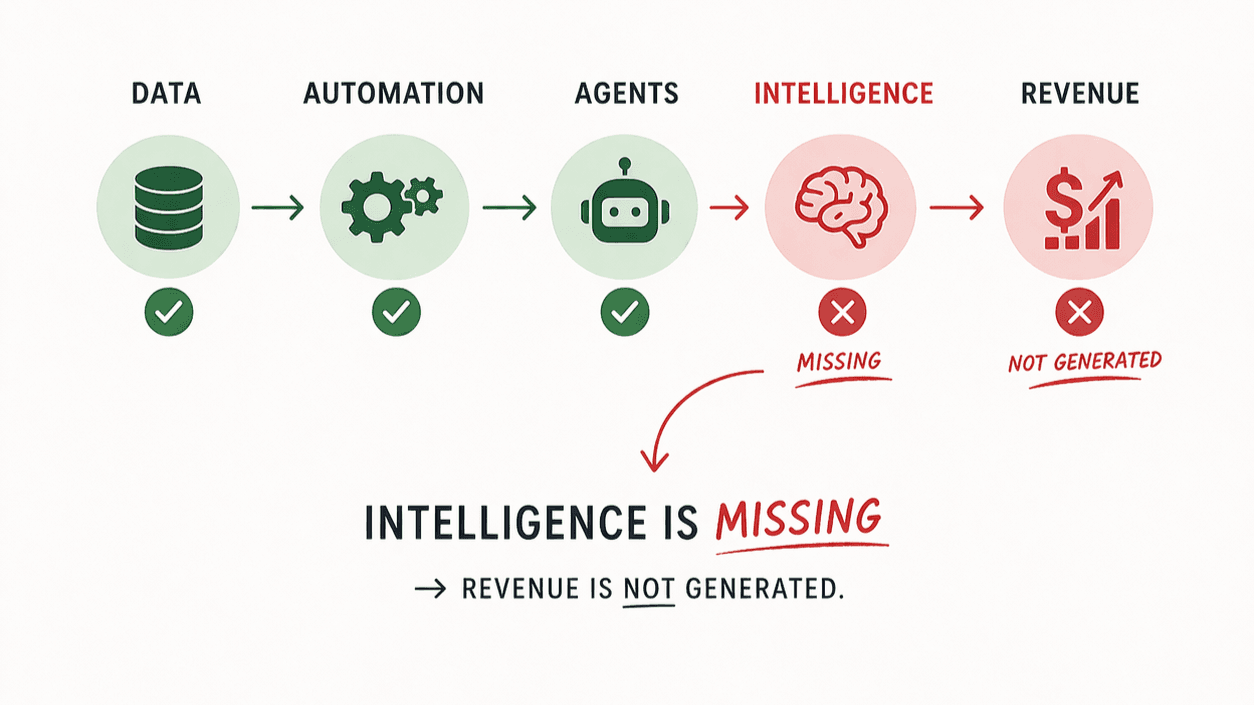
A few weeks ago I was sitting with a CS lead at a SaaS company. Solid team, decent CRM hygiene, product usage data available, renewal dates tracked. They had recently started working with automation and had even deployed a few AI features. On paper, the infrastructure was there.
They had lost three high-value accounts in the previous quarter. In two of the three cases, the signals had been visible for months.
This is not an unusual story.
What most teams have built
The data side is usually in reasonable shape. Product usage somewhere in the backend. Support tickets in a tool. CRM activity, contract values, renewal dates — accessible if you know where to look.
The automation side is increasingly in place too. Workflows that fire when a field changes. Alerts when a renewal date approaches. Sequences that trigger after a certain period of inactivity.
And more recently: agents and AI features. Copilots that summarise accounts. Tools that draft emails or pull CRM data on request. AI that assists with specific tasks when someone thinks to ask it.
What almost no team has built is the layer that makes all of this work together.
The part that reads across all sources simultaneously, recognises what a specific combination of signals means for a specific account at a specific lifecycle stage, and routes to the right response before anyone has to manually look for it. Without this layer, agents operate in isolation. They respond when prompted but they cannot proactively connect signals, form a diagnosis, and decide what needs to happen next. The intelligence layer is what gives them that ability.
Dashboards show you what happened. This layer tells you what it means and what to do next.
Why it is hard to build
The difficulty is not technical. The data is usually there. The automation capability is usually there. The agents are increasingly there too. What is missing is the decision logic, and decision logic is hard to build because most of it has never been written down.
It lives in the heads of CSMs who have been with the company long enough to recognise patterns. It lives in the institutional memory of a CS lead who knows that accounts in a certain industry behave differently in year two. It lives in post-mortems that happened after a churn that nobody documented properly.
When I work with CS teams on this, the first and most important step is always the same: making the implicit explicit. Which combinations of signals actually predict churn in your customer base, not in general, but for your customers, at each lifecycle stage:
- What a yellow account in year one looks like versus year three.
- What the difference is between an account that is disengaging and one that has had a champion change.
This is what AI needs to work well in CS. Not generic inputs. The structured knowledge of what your customers do, what it means, and what your team should do about it. Context, in the most practical sense of the word.
What the layer actually does
Once that logic is explicit, the output changes significantly.
Instead of a CSM starting their day by manually reconstructing which accounts need attention, they open a prepared list. Each account comes with a diagnosis, not just a status but an explanation. Not "Account X is at risk" but: no login in 34 days, response rate dropped 28% last month, 61 days from renewal, pattern matches accounts that churned in Q3 last year. And a prepared action. The briefing is already written. The recommended next step is already there.
The CSM reviews and decides. The intelligence did the preparation.
The same layer works in both directions. An account absorbing value efficiently, approaching its usage ceiling, with a rising response rate is not a retention case. It is a revenue conversation. The system surfaces it the same way it surfaces a risk.
Retention and expansion stop being two separate work streams and become one continuous view of the portfolio.
And the agents that previously waited to be prompted now have something to work with. They know which accounts need attention, why, and what the recommended response is. The intelligence layer is what turns isolated AI features into a coordinated system.
Where to start
Not with tooling. With a signal audit.
Write down the three most common reasons accounts churned in the last 12 months. Then ask:
- Were those signals visible in your data 60 days before the renewal?
- If yes, why did nothing catch them?
- If no, what would need to be tracked to make them visible next time?
That gap is where the intelligence layer lives.
Most teams are closer than they think. The signals exist. The automation exists. The agents exist. What is missing is the logic that connects them, and the discipline to write it down rather than leaving it in someone's head indefinitely.
What does the signal-to-action gap look like in your CS organisation? I would be curious to hear.