- 27.04.2026
- AI
AI Foundations Eat "SaaSpocalypse" for Breakfast
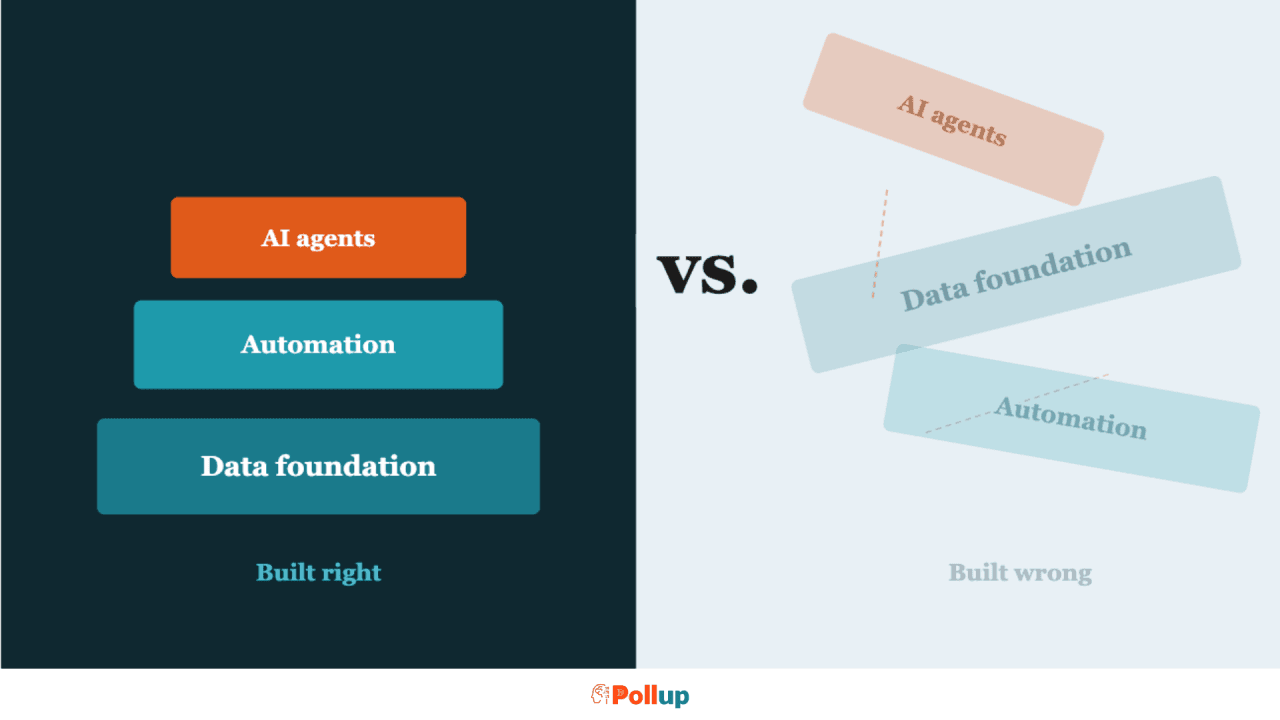
Why the market selloff narrative misses the real crisis, and what customer success and revenue teams should focus on.
Last week, HubSpot CEO Yamini Rangan pushed back hard on the markets. With 40% of her company's value gone since January, her argument was sharp: the SaaSpocalypse narrative confuses what software companies make with what they actually sell.
Vibe coding didn't kill domain expertise. It didn't kill integration work. It didn't kill the trust that makes a customer renew.
She's right. The real threat to B2B SaaS revenue isn't that AI can write code faster. It's that most revenue and customer success teams are sitting on a foundation that can't tell them where their next euro of growth is coming from — and they're about to get lapped by the ones that can.
The successful teams aren't the ones defining AI adoption as "spending as many AI tokens as you can". They're the ones who built the right foundation before deploying AI agents and tools.
The real SaaSpocalypse
The SaaSpocalypse that actually matters isn't AI eating software. Let's reframe that. It's revenue teams that spent years chasing new logos while their existing customer base was leaking. AI didn't create that structural problem. It just made it more expensive — and more visible — to ignore.
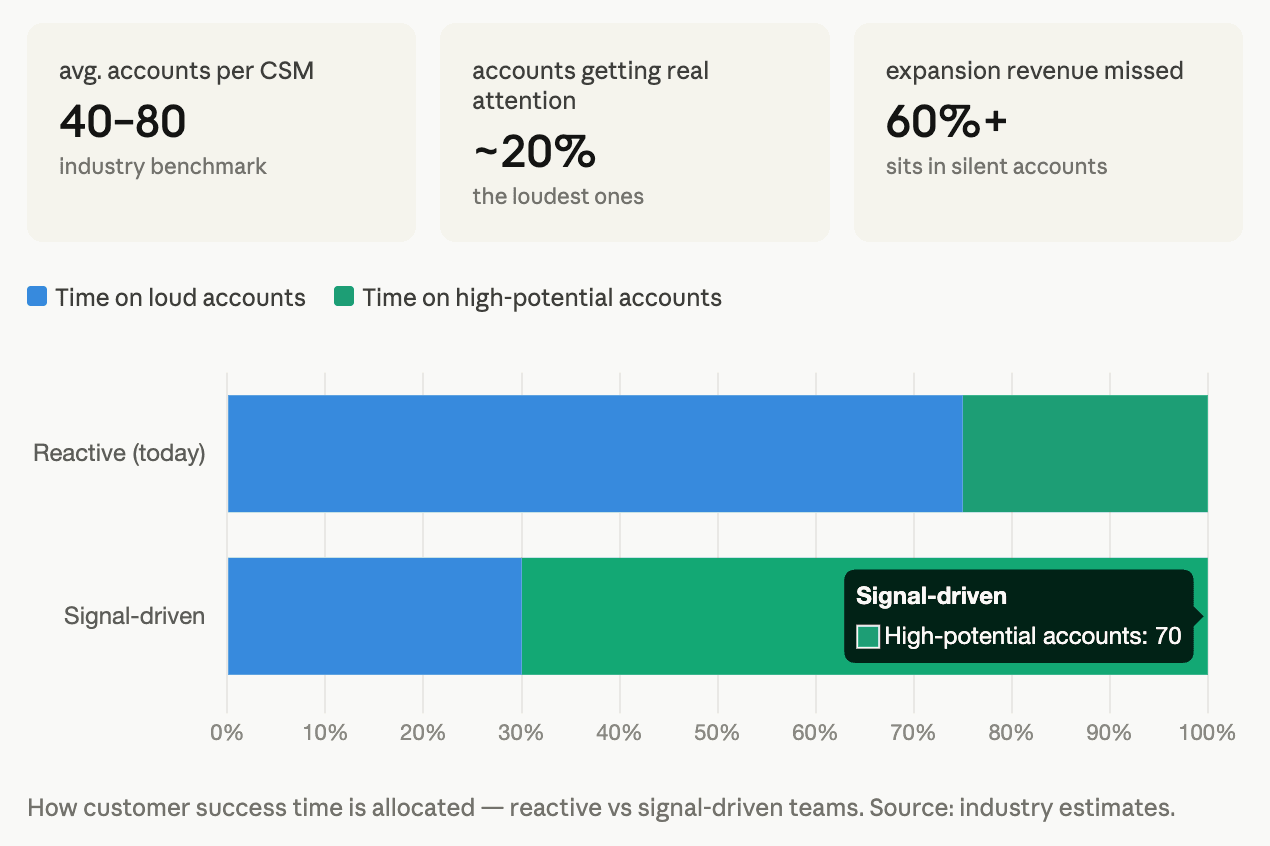
The next revenue frontier isn't acquisition. It's the accounts already in the portfolio that nobody is really watching.
Most customer success teams know this intuitively. But knowing it and acting on it are two different things, and the gap is almost always a data problem dressed up as a capacity problem. Most teams don't have a headcount problem. They have a signal problem.
And when you solve the signal problem, you stop chasing every account and start showing up to the right ones, with something worth saying.
Busy teams, even busier clients
A QBR invitation that lands without a clear agenda, without context, without something genuinely useful to discuss? Just another meeting nobody needed. Customer success and account management teams carry the weight of dozens of relationships simultaneously. And their clients are just as stretched. Quarterly pressures, internal politics, competing priorities.
This is the real attention crisis in customer success: not that account managers are busy, but that their clients are busier. The account managers who win mindshare aren't the ones who check in most often. They're the ones who show up with something worth the thirty minutes. A usage pattern the client hadn't noticed. An expansion opportunity framed around the client's own goals. A risk surfaced before it became a conversation the client had to initiate.
The best customer success managers don't fight for their clients' attention. They earn it by arriving with context the client couldn't have assembled themselves.
That context doesn't come from gut feel or tribal knowledge. It comes from connected data — product usage, ticket history, CRM signals — synthesized by an AI agent that prepares a QBR agenda or a follow-up brief in minutes.
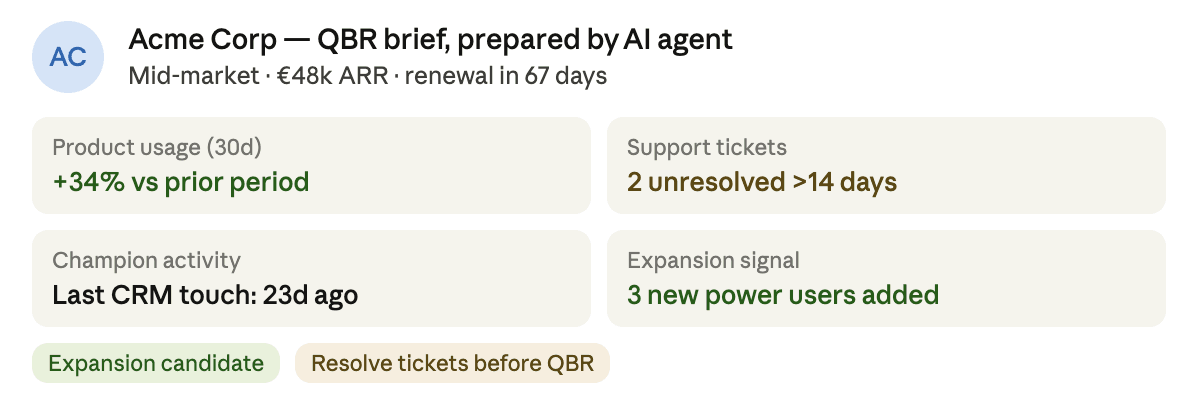
This isn't a vision of the future. It's what happens when the foundation is built before the automation.
Signal before scale
The issue is rarely intent. Revenue leaders know expansion matters. Customer success leaders know proactive beats reactive.
The blocker is always signal — or rather, the absence of clean, connected signals. When the CRM, product usage data, and support tickets all live in separate systems that don't talk to each other, teams fly blind. They react to noise. They miss the patterns that actually predict retention and growth.
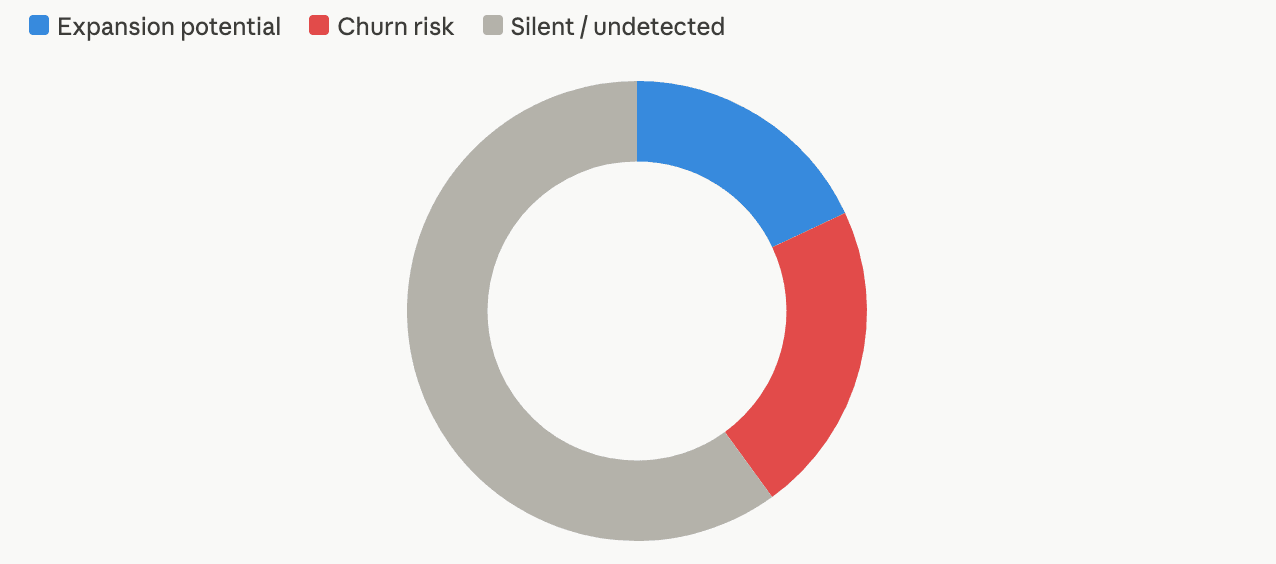
At pollup.ai, this is where we spend most of our time before touching a single automation. We clean the foundation first. We connect the data sources and build an intelligence layer that surfaces patterns customer success and account management teams can't see at scale: which accounts are quietly expanding, which are silently at risk, and which have been invisible long enough that nobody remembers to check.
Automation built on a dirty foundation is just noise made fast and efficient. Fix the signals first. Then scale.
The foundation problem is also an economical one
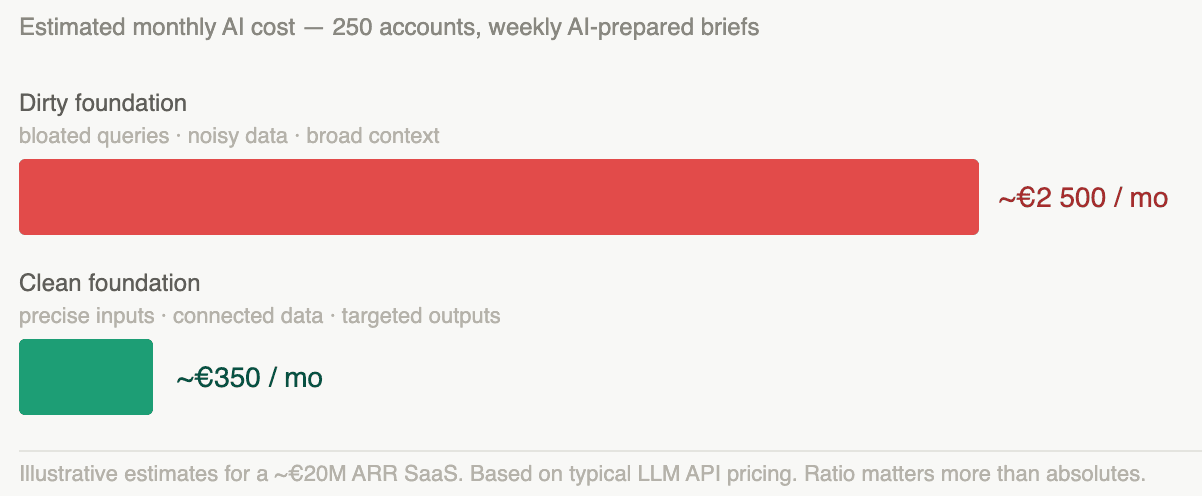
There is also a cost argument that rarely gets made explicitly. Most AI tools have pricing models based on usage volume. The moment the workflows scale across a full account portfolio, the economics change fast. Running bloated, poorly scoped AI queries on hundreds of accounts every week is not just slow — it is expensive. The teams that will scale AI sustainably in a pay-as-you-use motion are the ones who designed for efficiency from the start: clean inputs, precise context, targeted outputs. That discipline starts with the foundation, not the tooling.
A word on how to build foundations
Building data and AI systems for revenue teams is never purely a technical project. RevOps, customer success leadership, sales, and product all carry different definitions of what a healthy account looks like. Different opinions on what "at risk" means. Different ideas about who owns the expansion motion. Getting alignment on what the data should tell each team — and who acts on it — matters as much as the technology itself. Stakeholder alignment is part of the build, not an afterthought to it.
The SaaSpocalypse debate will keep running. Markets will keep overreacting. But the revenue teams that come out ahead won't be the ones who waited for the narrative to settle. They'll be the ones who spent this window cleaning their data, connecting their signals, and giving their customer success and account management teams the context to walk into every conversation like they've already done the work.
Want to find out how much NRR potential is sitting untouched in your existing base right now? We built a 3-minute check for exactly that. Six questions, no open text, instant result. No email required: pollup.ai/nrr_assessment_pollup.html